
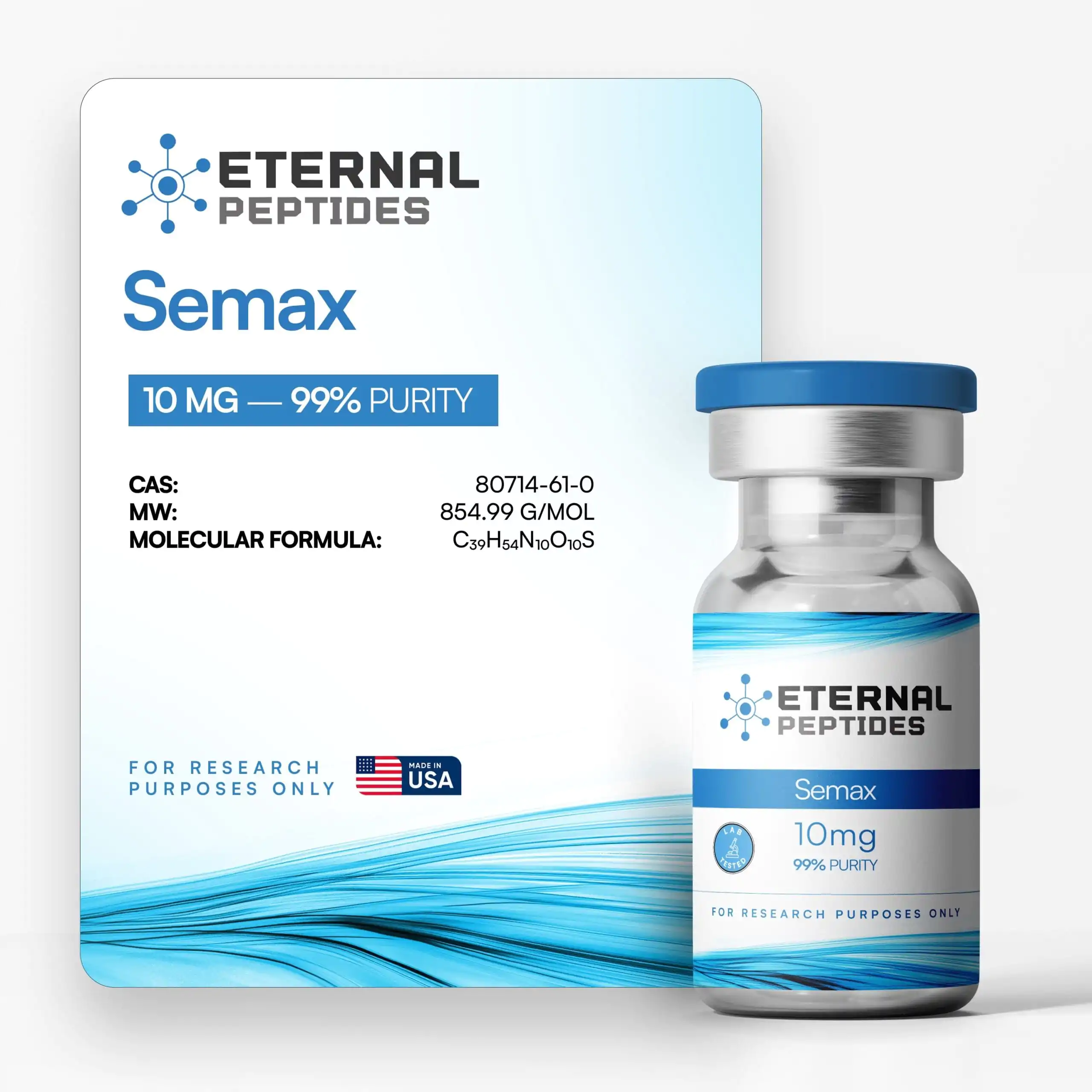
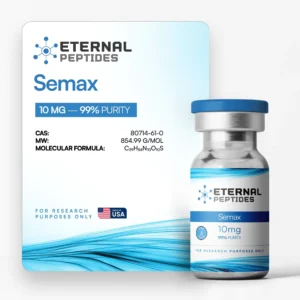
Semax
$34.99 – $54.99Price range: $34.99 through $54.99
Discount per Quantity
| Quantity | Discount | Price |
|---|---|---|
| 5 – 10 | 5% | $52.24 |
| 11 – 20 | 10% | $49.49 |
| 21+ | 15% | $46.74 |
Guaranteed
Ordering
Tested
Tracking
Commitment
Rigorous Third-Party Testing
Every batch of our research chemicals and peptides undergoes
third-party testing.
*Disclaimer: This product is intended solely for laboratory research purposes. It is not suitable for consumption by humans, nor for medical, veterinary, or household purposes. Kindly review our Terms & Conditions before making a purchase.

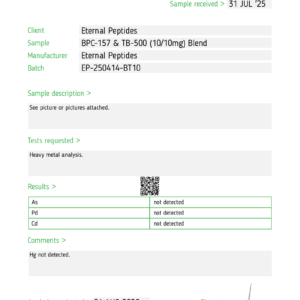
Always quality-tested, verified with third-party COAs
At every step, we prioritize quality by conducting rigorous third-party testing on all our products. These tests focus on five key characteristics- identity, purity, sterility, and endotoxin levels, and heavy metal content-ensuring that each product meets the highest standards of quality with independent third-party Certificates of Analysis (COAS) to verify our commitment to excellence.
Order Semax 10mg from Eternal Peptides, a trusted supplier of research peptides known for rigorous purity and quality standards. Our high-purity Semax is independently verified through third-party testing, with Certificates of Analysis available for every batch. Semax is a synthetic peptide widely studied in neuroscience research for its effects on cognitive function, neuroprotection, memory processes, and focus-related pathways. Shop competitively priced Semax 10mg today and enjoy fast, secure USPS shipping—free on orders over $200—with dedicated 24/7 U.S.-based support. For research use only.
What is Semax?
Semax is a synthetic heptapeptide originally developed in Russia during the 1980s by researchers at the Institute of Molecular Genetics of the Russian Academy of Sciences. Its amino acid sequence (Met-Glu-His-Phe-Pro-Gly-Pro) was designed as a stabilized analogue of the naturally occurring ACTH(4–10) fragment, a segment of adrenocorticotropic hormone involved in neuroregulatory signaling.
Unlike endogenous ACTH fragments, Semax was engineered to resist rapid enzymatic breakdown, resulting in improved stability and prolonged activity in experimental settings. This enhanced durability has made it a valuable compound for controlled laboratory studies where consistent exposure and reproducible results are important.
Scientific literature has primarily explored Semax in the context of nootropic and neuroprotective research. Published studies examine its influence on memory formation, attention, learning performance, neuroplasticity, BDNF (brain-derived neurotrophic factor) signaling, stress adaptation, and post-ischemic recovery models.
Most mechanistic findings come from in vitro systems and rodent studies, while limited preliminary clinical data has appeared in Russian medical literature. Although promising in research settings, Semax is not approved for therapeutic use by the FDA or other major regulatory authorities.
Its strong aqueous solubility, stability in lyophilized form, and consistent synthetic manufacturing profile make Semax especially suitable for modern research protocols involving reconstitution, storage, and repeatable dosing.
How Semax Works: Mechanistic Overview
Semax appears to act through several interconnected neurobiological pathways rather than one single receptor target. Research suggests the peptide modulates neurotrophic signaling, monoamine neurotransmission, gene expression, and cellular stress-response pathways within the central nervous system.
Preclinical studies report effects such as:
- Increased BDNF and NGF expression
- Enhanced synaptic plasticity markers
- Modulation of dopamine and serotonin turnover
- Reduced neuronal damage after ischemic injury
- Improved memory retention in animal learning models
- Better resilience to stress-related behavioral changes
Rather than behaving like a direct stimulant or sedative, Semax is generally studied as a regulatory peptide influencing adaptive brain function.
BDNF and Neuroplasticity Support
One of the most studied aspects of Semax is its effect on brain-derived neurotrophic factor (BDNF), a protein critical for learning, memory, neuronal survival, and synaptic remodeling.
Animal studies demonstrate increased BDNF expression in the hippocampus and frontal cortex following Semax administration. These changes are associated with:
- Stronger long-term potentiation (LTP)
- Improved spatial learning
- Better memory consolidation
- Increased neuronal resilience
Because BDNF plays a central role in neuroplasticity, Semax is frequently investigated in cognition-focused research models.
Dopamine, Serotonin, and Attention Pathways
Semax has also been studied for its influence on monoaminergic neurotransmitter systems, especially dopamine and serotonin pathways.
Rodent data suggests altered neurotransmitter turnover in regions linked to motivation, focus, reward, and mood regulation. These findings may explain why Semax is often researched in models involving:
- Attention performance
- Executive function
- Stress resilience
- Motivation-related behavior
- Cognitive flexibility
Unlike classic stimulants, Semax does not appear to produce the same hyperactivity patterns in preclinical models.
Neuroprotection and Ischemia Research
Semax has gained substantial attention in stroke and ischemia studies. Experimental models of cerebral ischemia show that Semax may reduce infarct volume, improve behavioral recovery, and influence protective gene-expression pathways after injury.
Observed mechanisms include:
- Reduced oxidative stress
- Lower inflammatory signaling
- Improved neuronal survival
- Enhanced post-injury recovery markers
- Better vascular and immune response regulation
These findings remain preclinical and are not evidence of approved medical use.
Semax Research Value (Applications)
Researchers commonly investigate Semax across several domains:
Cognitive Function Studies
Used in learning, memory, and attention experiments involving maze tasks, recall tests, and executive-function models.
Neuroprotection Research
Studied in stroke, hypoxia, traumatic injury, and neurodegeneration models.
Stress Adaptation Models
Examined for effects on corticosterone balance, anxiety-like behavior, and resilience under chronic stress.
Neuroplasticity & Recovery
Used in studies focused on synaptic remodeling, trophic signaling, and post-injury adaptation.
Semax Peptide Characteristics
| Property | Details |
|---|---|
| Name | Semax |
| Sequence | Met-Glu-His-Phe-Pro-Gly-Pro |
| Molecular Formula | C₃₇H₅₁N₉O₁₀S |
| Molecular Weight | 813.9 g/mol |
| Product Form | Lyophilized powder in 10mg vial |
| Purity | ≥99% (third-party verified) |
| Solubility | Sterile water / bacteriostatic water / saline |
| Storage | Refrigerated or frozen after receipt |
Handling & Storage Guidelines
To maintain stability and research integrity:
- Store unopened vials frozen or refrigerated, protected from light and moisture
- Reconstitute using sterile bacteriostatic water or sterile lab-grade water
- Swirl gently—do not shake aggressively
- Refrigerate reconstituted solution at 2–8°C
- Aliquot for long-term frozen storage
- Avoid repeated freeze-thaw cycles
- Use standard PPE and laboratory handling protocols
COA / Quality Assurance
Every Semax batch from Eternal Peptides includes lot-specific quality documentation for transparency and reproducibility.
Typical COA data includes:
- Identity verification (HPLC / MS)
- Purity analysis
- Batch traceability
- Storage recommendations
- Independent third-party testing confirmation
This helps researchers maintain documentation standards and experimental consistency.
Legal / Regulatory Disclaimer
Semax is sold strictly for laboratory research use only. This product is not approved by the FDA for human consumption, veterinary use, therapeutic treatment, or diagnostic purposes.
Purchasers are responsible for complying with all local, state, federal, and institutional regulations regarding possession, handling, and use of research compounds.
Scientific References
- Dmitrieva VG et al. Cell Mol Neurobiol. 2010.
- Romanova GA et al. Bull Exp Biol Med. 2006.
- Agapova TIu et al. Mol Gen Mikrobiol Virusol. 2008.
- Dolotov OV et al. Brain Res. 2006.
- Eremin KO et al. Dokl Biol Sci. 2004.
- Medvedeva EV et al. BMC Genomics. 2014.
- Radchenko AI et al. Acta Naturae. 2025.
- Glazova N et al. J Evol Biochem Physiol. 2023.
Related Products
Related products

,
,