
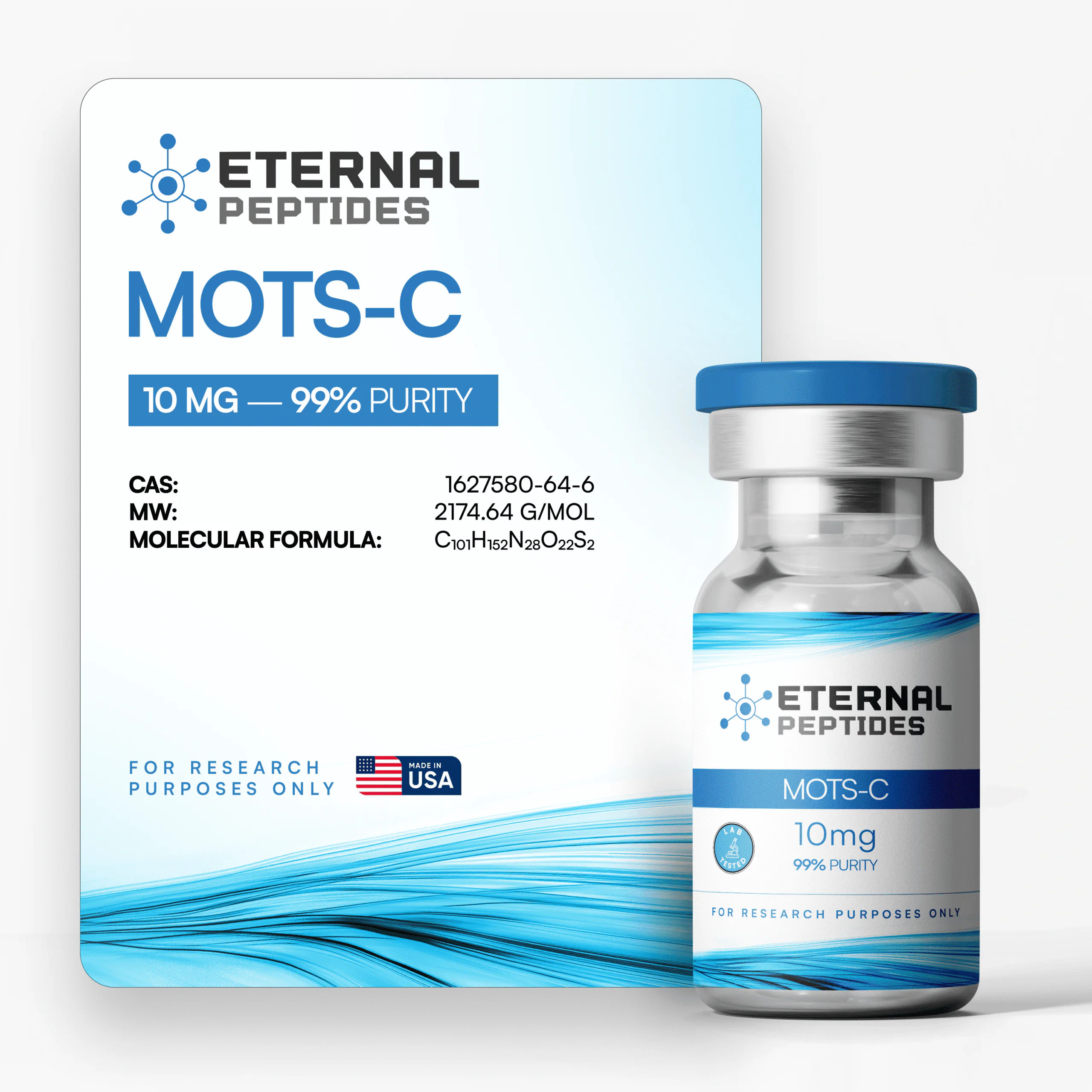







MOTS-C (10mg)
$65.00 Original price was: $65.00.$59.99Current price is: $59.99.
Discount per Quantity
| Quantity | Discount | Price |
|---|---|---|
| 5 – 10 | 5% | $56.99 |
| 11 – 20 | 10% | $53.99 |
| 21+ | 15% | $50.99 |
Guaranteed
Ordering
Tested
Tracking
Commitment
Rigorous Third-Party Testing
Every batch of our research chemicals and peptides undergoes
third-party testing.
*Disclaimer: This product is intended solely for laboratory research purposes. It is not suitable for consumption by humans, nor for medical, veterinary, or household purposes. Kindly review our Terms & Conditions before making a purchase.

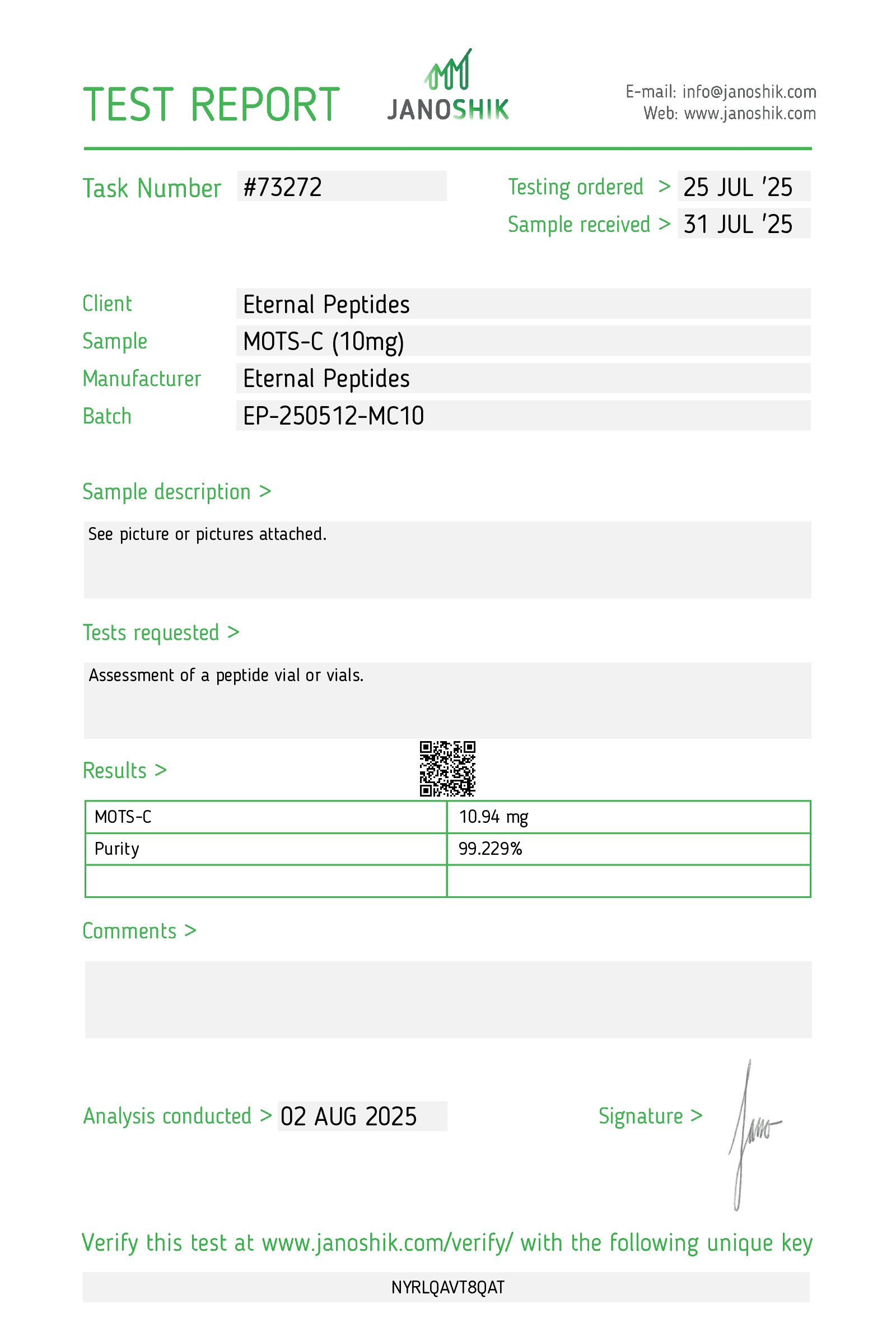
Always quality-tested, verified with third-party COAs
At every step, we prioritize quality by conducting rigorous third-party testing on all our products. These tests focus on five key characteristics- identity, purity, sterility, and endotoxin levels, and heavy metal content-ensuring that each product meets the highest standards of quality with independent third-party Certificates of Analysis (COAS) to verify our commitment to excellence.
Shop premium-grade MOTS-C 10mg from Eternal Peptides, a trusted U.S. supplier of verified research compounds. This mitochondria-derived peptide is manufactured to a purity standard of ≥99%, with every batch independently tested and certified by Janoshik Analytical. MOTS-C is widely used in research focused on AMPK activation, cellular energy regulation, and metabolic flexibility. Order today for fast, secure U.S. shipping and free Priority delivery on all orders over $200.
What Is MOTS-C?
MOTS-C (Mitochondrial Open Reading Frame of the 12S rRNA-C) is a short mitochondria-derived peptide classified within the family of mitochondrial-derived peptides (MDPs). It is encoded by mitochondrial DNA rather than the nuclear genome, making it structurally and functionally distinct from most conventional signaling peptides.
In simpler terms, MOTS-C is a synthetic research analogue of a naturally expressed mitochondrial peptide first identified through genomic analysis of mitochondrial open reading frames.
In scientific literature, MOTS-C is primarily studied for its potential role in mitochondrial signaling, cellular metabolism, and adaptive energy regulation. Preclinical research has explored its involvement in metabolic stress responses, insulin sensitivity, and exercise-related signaling, with most available findings coming from in vitro and animal models.
Mechanistically, MOTS-C has been associated with modulation of pathways involved in glucose utilization, fatty acid oxidation, and cellular stress adaptation, potentially through communication between mitochondrial and nuclear signaling systems. Since controlled human clinical evidence remains limited, these findings should be interpreted strictly within a research context.
How MOTS-C Works (Mechanism of Action)
MOTS-C is considered a pleiotropic mitochondria-derived peptide studied mainly for metabolic regulation and cellular stress adaptation. Current mechanistic understanding comes largely from cell-based systems and animal research, where MOTS-C appears to influence several pathways linked to energy balance, mitochondrial efficiency, and cellular resilience.
AMPK Activation and Energy Sensing
One of the most frequently reported mechanisms of MOTS-C involves activation of AMP-activated protein kinase (AMPK), a central regulator of cellular energy status. In preclinical studies, MOTS-C has been shown to increase AMPK signaling in metabolically active tissues, particularly skeletal muscle. This pathway is often studied alongside NAD+ metabolism due to its importance in cellular energy regulation.
AMPK signaling plays a major role in maintaining cellular homeostasis when energy demand exceeds supply. By supporting this pathway, MOTS-C may help cells adapt to energetic stress, making it valuable in research models examining nutrient imbalance or metabolic strain.
Regulation of Glucose Metabolism and Insulin Sensitivity
Animal studies suggest MOTS-C may influence glucose metabolism by improving insulin sensitivity and enhancing glucose clearance from circulation. These effects appear linked to downstream AMPK signaling and altered expression of genes involved in glucose transport and utilization.
In research settings, these metabolic effects are important because impaired glucose handling is a hallmark of metabolic dysfunction. This helps explain why MOTS-C is frequently investigated in diet-induced metabolic stress models rather than acute tissue repair studies.
Nuclear Translocation and Gene Expression Modulation
Under conditions of metabolic or oxidative stress, MOTS-C has been observed to move from the mitochondria to the nucleus. Once there, it appears to interact with stress-responsive transcriptional programs, altering expression of genes involved in metabolism and cellular defense.
This mitochondrial-to-nuclear signaling suggests a broader role for MOTS-C as a communication molecule rather than a single-pathway regulator. In research, this mechanism is significant because it indicates coordination of adaptive responses across multiple cellular compartments.
Interaction With the Folate–Methionine Cycle
Preclinical studies suggest MOTS-C may influence the folate–methionine cycle, a metabolic pathway closely linked to amino acid balance and cellular redox status. By modulating this cycle, MOTS-C may indirectly affect the availability of metabolic intermediates needed for stress adaptation and energy regulation.
This mechanism is particularly relevant in models focused on nutrient sensing and metabolic flexibility, reinforcing the concept of MOTS-C as a regulator of interconnected metabolic networks rather than a direct growth signal.
Exercise-Mimetic and Stress Adaptation Effects
In animal models, MOTS-C administration has been associated with molecular changes resembling those seen during physical exercise, including enhanced mitochondrial efficiency and improved metabolic flexibility. These findings have led some researchers to describe MOTS-C as having exercise-mimetic signaling properties.
From a research perspective, this makes MOTS-C valuable for studying how cells adapt to repeated energetic demand. However, these findings remain preclinical, and relevance to controlled human outcomes has not been firmly established.