DSIP
$34.99 – $59.99Price range: $34.99 through $59.99
Discount per Quantity
| Quantity | Discount | Price |
|---|---|---|
| 5 – 10 | 5% | |
| 11 – 20 | 10% | |
| 21+ | 15% |
Guaranteed
Ordering
Tested
Tracking
Commitment
Rigorous Third-Party Testing
Every batch of our research chemicals and peptides undergoes
third-party testing.
*Disclaimer: This product is intended solely for laboratory research purposes. It is not suitable for consumption by humans, nor for medical, veterinary, or household purposes. Kindly review our Terms & Conditions before making a purchase.

Always quality-tested, verified with third-party COAs
At every step, we prioritize quality by conducting rigorous third-party testing on all our products. These tests focus on five key characteristics- identity, purity, sterility, and endotoxin levels, and heavy metal content-ensuring that each product meets the highest standards of quality with independent third-party Certificates of Analysis (COAS) to verify our commitment to excellence.
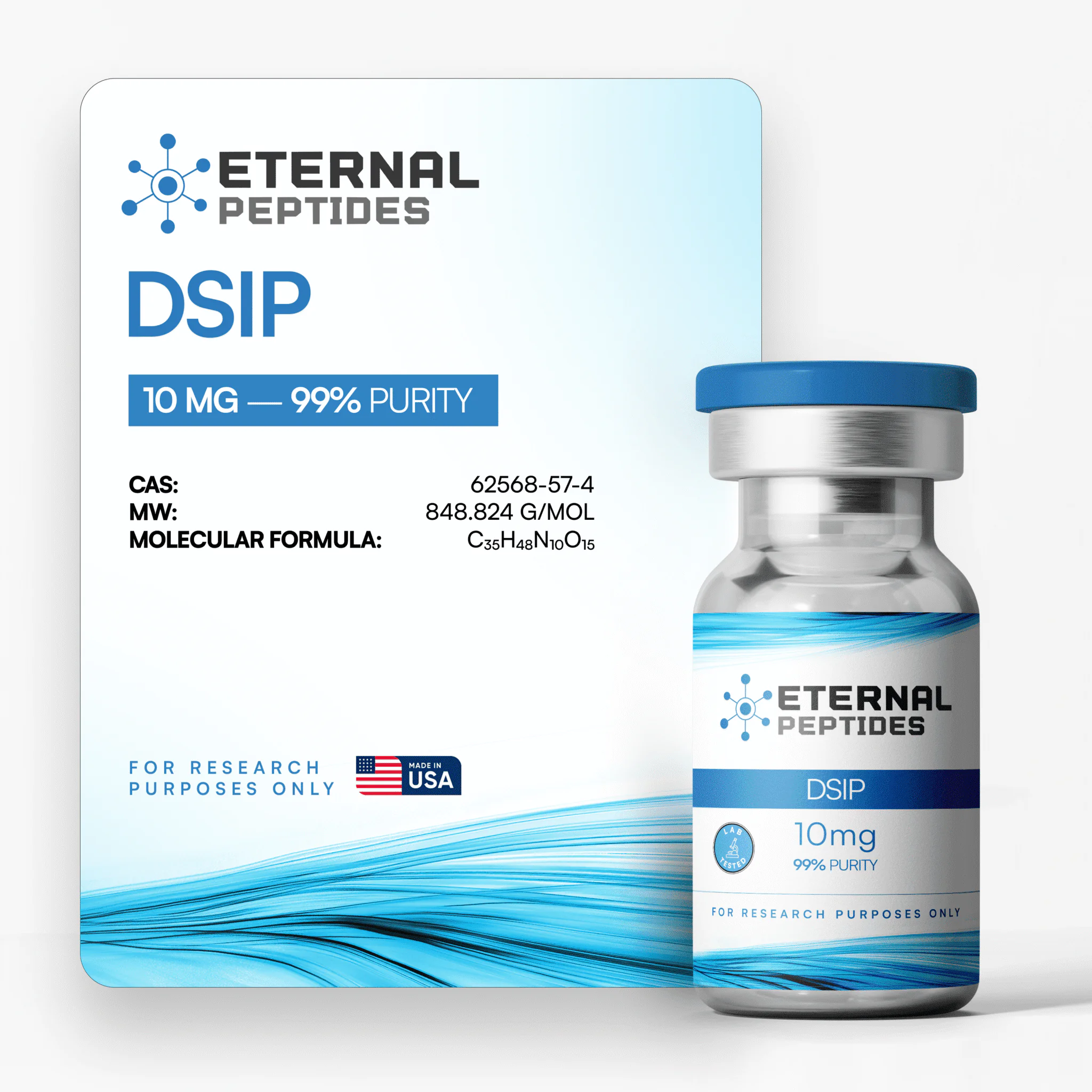
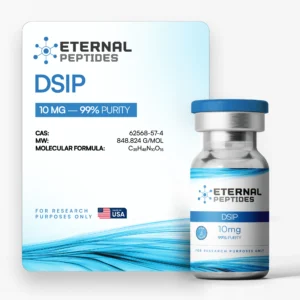
Order DSIP 5 mg from Eternal Peptides, a reputable U.S.-based supplier of research compounds known for consistent quality and rigorous third-party laboratory verification. Each batch of this high-purity Delta Sleep-Inducing Peptide (DSIP) is independently tested and supplied with Certificates of Analysis to ensure identity and purity standards. DSIP is offered in 10 mg vials at competitive pricing, with free USPS Priority shipping on orders over $200 and dedicated customer support. This product is strictly intended for research use only.
What is DSIP?
Delta Sleep-Inducing Peptide (DSIP) is a naturally occurring neuropeptide made up of nine amino acids: Trp-Ala-Gly-Gly-Asp-Ala-Ser-Gly-Glu. It was first identified in 1977 in the cerebral venous blood of rabbits during slow-wave sleep by Swiss scientists Schoenenberger and Monnier.
This peptide is found in both the central nervous system and peripheral tissues, as well as in circulating plasma, suggesting it plays multiple roles in physiological regulation.
Research has focused on DSIP for its possible involvement in sleep regulation, stress adaptation, pain modulation, and neuroendocrine activity. Studies have also explored its effects on hormone regulation, oxidative stress responses, and neuroprotection.
Most available data comes from laboratory and animal research, especially rodent models examining sleep cycles, stress hormones, and behavioral responses.
Because of its small size and simple structure, DSIP is relatively stable in solution and easy to handle in experimental environments, making it useful in controlled laboratory studies. Its good water solubility also allows precise dosing in research setups.
How DSIP Works: Mechanistic Overview
DSIP is thought to act through several neuroendocrine and cellular pathways, although its exact mechanism is not fully understood. Evidence suggests it influences sleep regulation by interacting with GABA and serotonin systems, affecting neurotransmitter release in brain regions involved in sleep control.
It may also interact with the hypothalamic-pituitary-adrenal (HPA) axis, helping regulate stress hormones such as corticotropin and cortisol in animal studies. In addition, DSIP has shown possible antioxidant and cell-protective properties by influencing oxidative stress pathways.
In animal experiments, DSIP has been linked to changes in sleep structure, including increases in deep slow-wave sleep and shifts in REM patterns. It has also been observed to reduce stress-related behaviors and normalize hormone levels in stress models, with potential pain-modulating effects as well.
Sleep Regulation Effects
Studies suggest DSIP may influence GABAergic signaling, the brain’s main inhibitory system, potentially enhancing neural relaxation in sleep-related brain areas.
It may also affect serotonin activity, with changes observed in receptor sensitivity and neurotransmitter turnover in animal brains. Some electrophysiological studies report increased delta brain wave activity and longer periods of deep sleep after DSIP administration.
These findings make DSIP useful in research on disrupted sleep, circadian rhythm changes, and sleep disorders in animal models, although human relevance is still unclear.
Stress Response and HPA Axis
DSIP has been studied for its effects on the body’s stress system. In animal stress models, it has been associated with reduced release of stress hormones such as cortisol and ACTH.
Research suggests it may act on the hypothalamus and pituitary gland to moderate stress responses and improve feedback regulation of glucocorticoids.
Behavioral studies in rodents show reduced anxiety-like responses and improved adaptation to repeated stress exposure, making DSIP relevant in stress physiology research.
Antioxidant and Cellular Protection
Some studies indicate DSIP may reduce oxidative stress in cells by lowering lipid peroxidation and supporting antioxidant enzymes like catalase and superoxide dismutase.
Animal experiments also suggest protective effects in brain tissue exposed to oxidative damage, including reduced cellular injury and improved mitochondrial stability.
These effects appear to result from regulation of oxidative stress pathways rather than direct free radical neutralization.
Research Limitations
Most DSIP research comes from laboratory cell studies and animal experiments, especially in rodents. Human clinical data is extremely limited, and its exact mechanism of action is still not fully defined.
Therefore, findings should be interpreted strictly within preclinical research contexts and not assumed to directly apply to human biology.
Research Applications Overview
DSIP is mainly used in scientific studies related to sleep, stress, pain, and oxidative stress. The observations below come from preclinical research and do not indicate any approved medical use.
Sleep Research
Animal studies show DSIP may increase deep sleep, reduce time to fall asleep, and improve sleep stability. It is also used to study sleep disruption and age-related sleep changes in laboratory models.
Stress Studies
DSIP has been linked to reduced stress hormone levels and decreased anxiety-like behavior in animals under stress conditions, helping researchers study stress adaptation mechanisms.
Pain Research
Some studies report increased pain thresholds and reduced pain responses in animals, suggesting DSIP may influence non-opioid pain pathways in experimental settings.
Oxidative Stress Models
Research indicates DSIP may help cells resist oxidative damage and improve survival under stress conditions in laboratory studies.
Key Characteristics
DSIP is a nine-amino-acid peptide with a molecular weight of 848.8 g/mol. It is supplied as a lyophilized powder in 5 mg vials with ≥99% purity verified by third-party testing.
It is stable when properly stored frozen and is soluble in sterile or bacteriostatic water for laboratory use.
Handling & Storage Summary
- Store lyophilized DSIP at -20°C, protected from light and moisture
- Reconstitute using sterile or bacteriostatic water
- Avoid repeated freeze-thaw cycles by aliquoting
- Store reconstituted solution in refrigerated conditions for short-term use
- Use sterile lab practices and protective equipment
Quality Assurance
Each batch comes with a Certificate of Analysis confirming identity, purity, sterility, and endotoxin levels. Testing is performed by independent third-party laboratories to ensure transparency and reproducibility.
Legal Notice
DSIP is strictly for laboratory research use only and is not approved for human or veterinary use. Buyers are responsible for complying with all applicable regulations and institutional guidelines. The supplier does not support or promote any non-research applications.