

BPC-157
$39.99 – $64.99Price range: $39.99 through $64.99
Guaranteed
Ordering
Tested
Tracking
Commitment
Rigorous Third-Party Testing
Every batch of our research chemicals and peptides undergoes
third-party testing.
*Disclaimer: This product is intended solely for laboratory research purposes. It is not suitable for consumption by humans, nor for medical, veterinary, or household purposes. Kindly review our Terms & Conditions before making a purchase.

Always quality-tested, verified with third-party COAs
At every step, we prioritize quality by conducting rigorous third-party testing on all our products. These tests focus on five key characteristics- identity, purity, sterility, and endotoxin levels, and heavy metal content-ensuring that each product meets the highest standards of quality with independent third-party Certificates of Analysis (COAS) to verify our commitment to excellence.
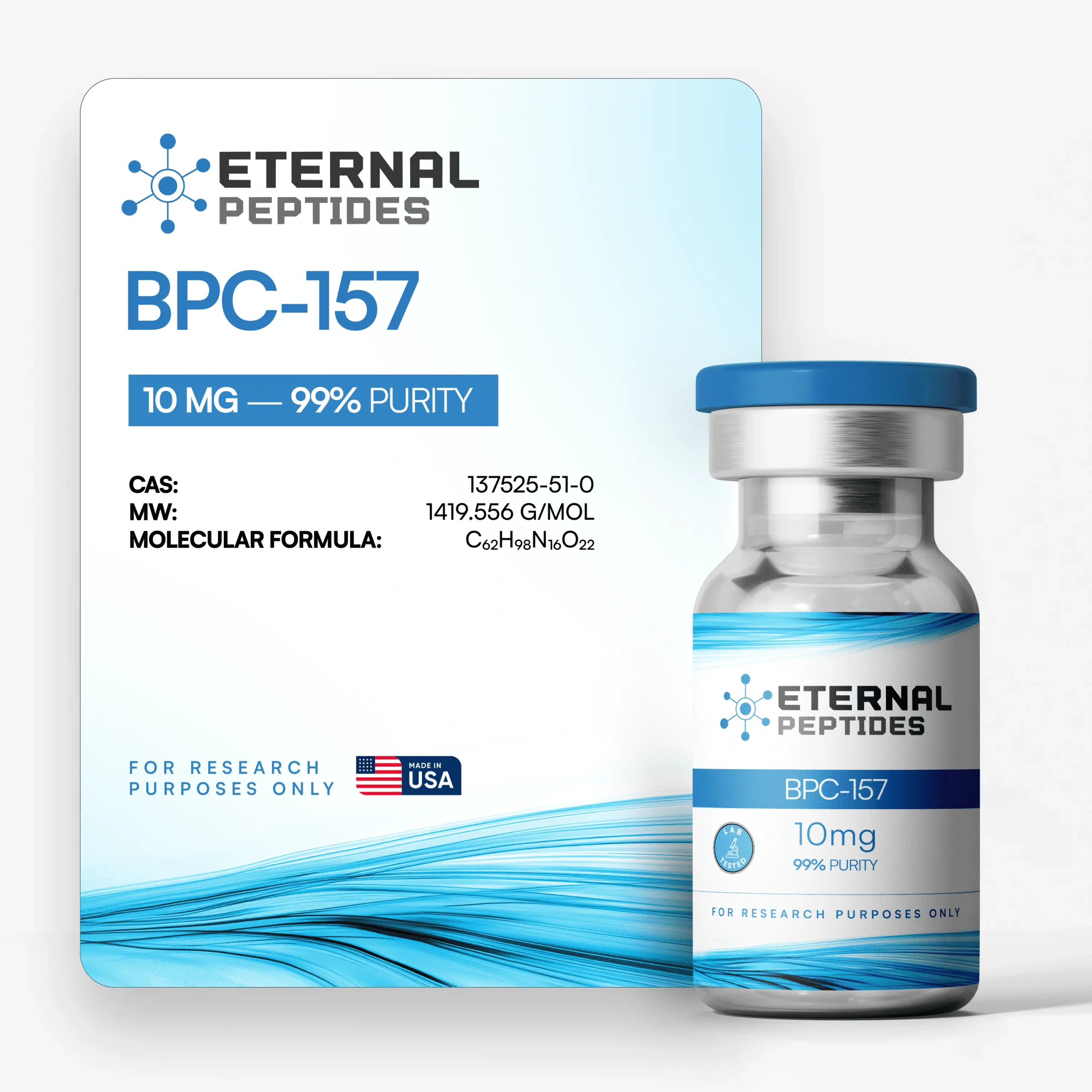
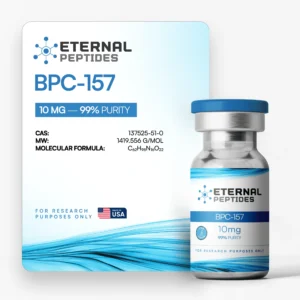
Purchase premium BPC-157 10mg vials from Eternal Peptides, a trusted name in verified quality and dependable research consistency. Our BPC-157 is manufactured to ≥99% purity, with each batch independently tested through third-party COAs (Janoshik) for confidence in laboratory applications. We offer complete traceability for both single and bulk orders, supported by 24/7 US-based customer service. Order now for secure, fast shipping, plus free Priority delivery on purchases over $200.
What Is BPC-157?
BPC-157 (Body Protection Compound-157) is a synthetic pentadecapeptide derived from part of a gastric protein known as BPC. It was originally identified as a stable peptide fragment present in gastric juice.
Preclinical research—mainly cell studies and rodent injury models—suggests BPC-157 may affect several repair-related pathways, including angiogenesis, extracellular matrix remodeling, and cytoprotection in tissues such as tendon, muscle, bone, and the gastrointestinal tract. However, these findings have not yet been confirmed in controlled human clinical trials, and most available evidence remains preclinical.
How BPC-157 Works (Mechanism of Action)
Current studies indicate BPC-157 has pleiotropic effects, meaning it may interact with multiple biological pathways rather than a single receptor target. Most evidence comes from animal and laboratory studies.
Angiogenesis and VEGF/VEGFR2
Research suggests BPC-157 may influence vascular endothelial growth factor (VEGF) expression and VEGFR2 activity, activating Akt–eNOS pathways involved in endothelial support, angiogenesis, and tissue revascularization.
This may help improve blood vessel formation and repair, potentially increasing delivery of oxygen and nutrients to healing tissues such as tendons, muscles, or gut lining. Enhanced circulation may contribute to recovery and vascular health.
Nitric Oxide Modulation and Cytoprotection
Studies indicate BPC-157 may help regulate nitric oxide (NO), reducing harmful excess production while maintaining normal physiological signaling.
Balanced NO activity is important for circulation, immune response, and tissue health. By modulating this pathway, BPC-157 may help protect cells from damage, reduce tissue stress, and support healing processes in injured tissues.
Anti-Inflammatory Signaling and ECM Support
Preclinical models suggest BPC-157 may affect inflammatory signaling and extracellular matrix remodeling. Through interactions with proteins such as FAK and paxillin, it may promote cell migration and tissue repair, helping wounds recover more efficiently.
Gastrointestinal Mucosal Protection
Animal studies have shown BPC-157 may assist in healing the lining of the stomach and intestines. It has demonstrated protective effects against ulcer-inducing agents while supporting mucosal recovery and gut barrier integrity.
CNS-Related Findings
Some animal studies suggest BPC-157 may offer neuroprotective effects by reducing neuroinflammation and supporting cerebral blood vessels. These findings remain preliminary, and human relevance has not been established.
BPC-157 Research Value
Tissue Repair Support
Preclinical studies report consistent effects across models involving wound healing, tendon or ligament injury, muscle damage, and GI irritation. Researchers value BPC-157 because it appears to influence multiple repair systems simultaneously, including inflammation, angiogenesis, nitric oxide signaling, and ECM remodeling.
Vascular Stability
Rodent studies indicate BPC-157 may support capillary repair and microvascular stability, making it useful in studying blood flow and healing under stress or ischemic conditions.
Gut Barrier Function
Early research focused heavily on gastrointestinal applications, where BPC-157 repeatedly showed protective effects against ulceration and toxin-related damage. This makes it relevant in studies of epithelial barrier integrity.
Systemic Healing Responses
Some studies note tissue improvements distant from injury sites, leading researchers to explore BPC-157 as a model for whole-body healing coordination rather than isolated tissue effects.
BPC-157 Characteristics
| Property | Detail |
|---|---|
| Name | BPC-157 (stable gastric pentadecapeptide) |
| Sequence | Gly-Glu-Pro-Pro-Pro-Gly-Lys-Pro-Ala-Asp-Asp-Ala-Gly-Leu-Val |
| Molecular Weight | ~1.4 kDa |
| Molecular Formula | C62H98N16O22 |
| Purity | ≥99% (verify with lot-specific COA) |
| Formats | 5mg powder, 10mg powder, 500mcg tablets |
| Batch | EP-250407-BPC10 |
Handling & Storage
Lyophilized Powder
- Store at –20°C protected from moisture and light
- Reconstitute with bacteriostatic water or approved solvents
- Aliquot after mixing to avoid repeated freeze-thaw cycles
- Use fresh working dilutions whenever possible
Tablets (500mcg)
- Store sealed at room temperature or 2–8°C
- Protect from humidity
- Dissolve only according to validated laboratory protocols
Powder vs Tablets
The main differences between powder and tablet forms relate to delivery method, stability, and experimental control. Powder is often preferred in research because it allows flexible concentrations and precise reconstitution. Tablets may introduce excipients, fixed dosing, and different exposure dynamics.
COA / Quality Assurance
Eternal Peptides provides Certificates of Analysis for every product lot, including powder vials and tablets. COAs typically include:
- Identity confirmation (HPLC and/or MS)
- Purity testing
- Endotoxin analysis
- Sterility testing (where applicable)
- Batch-specific storage guidance
Testing is conducted with Janoshik and other respected labs for transparency and traceability.
Legal Disclaimer
BPC-157 from Eternal Peptides is sold strictly for research use only. It is not intended for human or veterinary use, clinical treatment, or therapeutic administration. The compound has not been approved by regulatory authorities, and safety or effectiveness in humans has not been established.
Buyers are responsible for complying with all applicable laws, biosafety requirements, and research-use regulations.